Envato Just Changed Everything: What WordPress Authors Need to Do Before July 2026
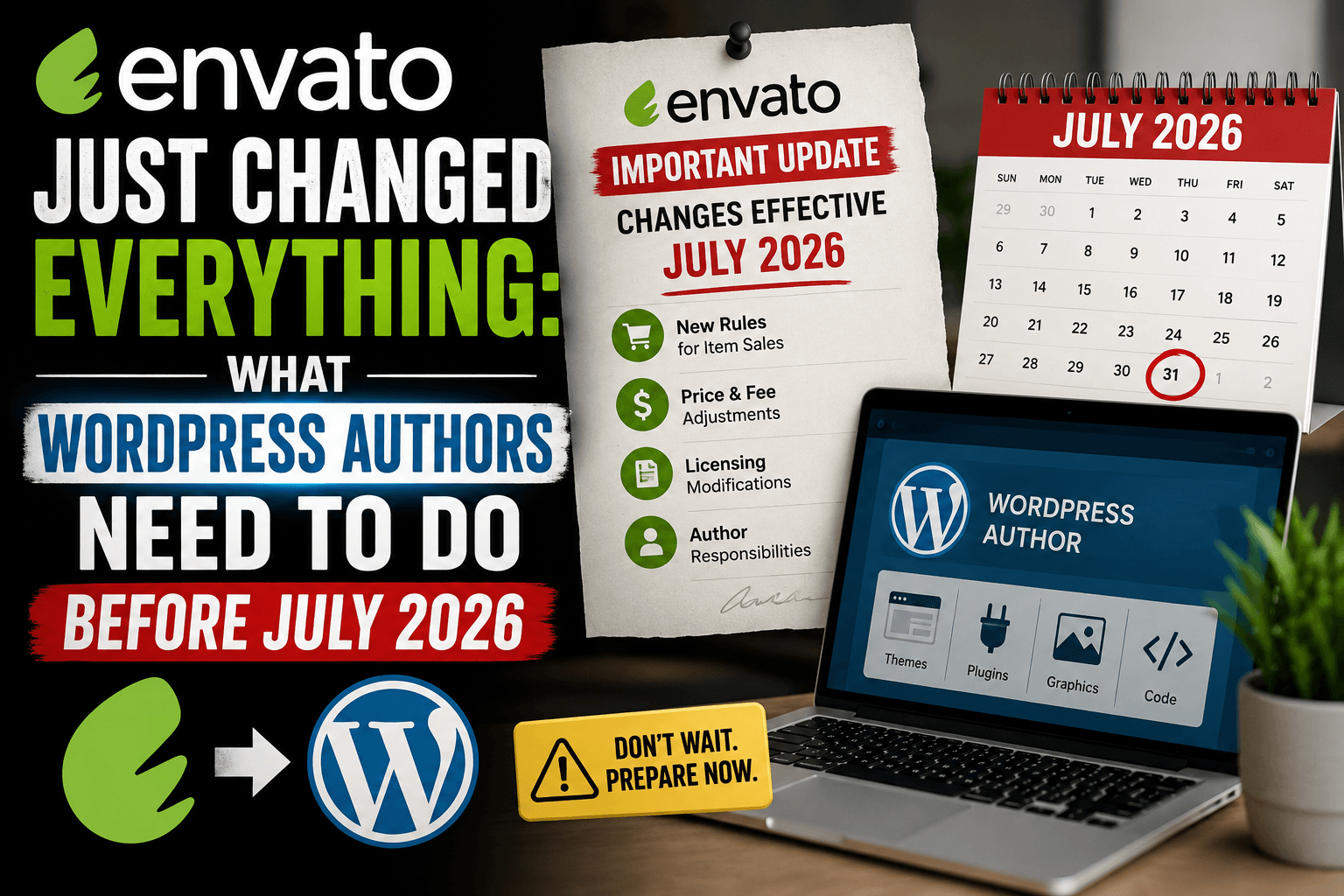
If you got the email from Envato this week, you already know something big is changing. If you didn't, here's the short version: from 1 July 2026, Envato is moving to a single flat 50% author fee for everyone — and removing exclusivity entirely.
That sounds almost reasonable until you do the math for exclusive authors. Some of you were keeping 75%, 80%, even 87.5% of each sale under the old exclusive tiered structure. Come July, everyone gets 50%. For high-earning exclusive authors, that's not a policy update — it's a revenue cut of 30 to 40 percentage points overnight.
So let's talk about what's actually happening, who wins, who loses, and what you should do before that date.
What Envato Actually Announced
The announcement, published on the Author Hub, outlines three changes taking effect on 1 July 2026:
- Exclusivity is gone. The exclusive/non-exclusive distinction is being removed completely. Every author will be on the same terms going forward.
- All authors move to a flat 50% fee. Envato takes 50% of the item price component of every sale, regardless of your sales history, tier, or longevity on the platform.
- You're free to sell anywhere. Since exclusivity no longer exists, you can sell the same products on your own site, other marketplaces, or anywhere else simultaneously — effective immediately.
That third point is the silver lining Envato is trying to lead with. The first two are the actual news.
Who This Hurts the Most
Under the old structure, exclusive authors earned more per sale as their lifetime earnings grew. The tiers worked roughly like this:
- New exclusive authors: kept ~62.5%
- Mid-tier exclusive authors: kept ~70–75%
- High-earning exclusive authors: kept ~80–87.5%
From July 2026, all of those become 50%.
If you're a long-term exclusive author who worked your way up to keeping 80% of every sale, this is a 37.5% reduction in your per-sale earnings overnight. On a $49 plugin, you were keeping ~$39. After July, you'll keep ~$24.50. Same product, same buyer, 37% less money in your pocket.
Non-exclusive authors were keeping 45% before. They'll now keep 50% — a slight improvement. So the change actually benefits the platform's smallest, newest contributors while cutting revenue for its most established ones. Make of that what you will.
Why Envato Is Doing This
The official framing is simplification and flexibility. One rate, no complexity, freedom to sell elsewhere.
The real reason is simpler. Shutterstock acquired Envato in July 2024. Shutterstock is a stock photography company. Its core business model is subscriptions — uniform, predictable, subscription revenue. The tiered commission structure that rewarded long-term exclusive authors was an Envato-era system built to incentivize loyalty to the marketplace. Shutterstock doesn't need that incentive anymore. They need operational simplicity and margin.
Flattening all authors to 50% is cleaner to manage and, for most of the author base, improves Envato's take-home per transaction. That's the full explanation.
What This Actually Means for Your Business
Here's the thing most authors haven't fully processed yet: the exclusivity removal is more significant than the fee change in the long run.
For years, being exclusive on Envato meant you legally couldn't sell your product anywhere else. Every sale had to go through CodeCanyon. If you wanted to build your own store, your own email list, your own brand — you couldn't. Not without giving up your exclusive rate and watching your earnings drop.
That restriction is gone on 1 July 2026.
From that date, you can run your own store and your Envato listing simultaneously. Every sale on your own site means you keep ~97% instead of 50%. Build enough direct traffic and your Envato listing becomes a secondary channel rather than your entire business.
That's the opportunity hiding inside what looks like bad news.
The Revenue Comparison Is Not Close
Let's be concrete. Selling a $49 plugin at 100 sales per month:
On Envato from July 2026 (50% flat fee):
- Your cut per sale: $24.50
- Monthly revenue: $2,450
- Annual revenue: $29,400
On your own store (0% platform fee, Stripe gateway only):
- Your cut per sale: ~$47.28 (after Stripe fees)
- Monthly revenue: $4,728
- Annual revenue: $56,736
Same plugin. Same price. Same number of sales. $27,336 more per year by selling directly.
That's not a marginal difference. That's the difference between a side income and a livable business. And it compounds every year you stay on Envato as your primary channel.
What You Should Do Before 1 July 2026
You have about six weeks from this writing. Here's how to use them.
1. Don't wait for July — start building your store now
The exclusivity restriction lifts on July 1, but nothing stops you from building everything beforehand. Get your domain, set up your hosting, configure your store, connect Stripe or PayPal, and build your product pages now. By July 1, you should be ready to take your first sale — not still figuring out hosting.
ChargePanda installs on any PHP-compatible server and covers everything you need out of the box: product pages, checkout, license key generation and REST API validation, subscription billing, affiliate management, and email campaigns. One setup, no extensions, no monthly fees.
2. Integrate license key validation into your plugin before July
This is the technical step most developers delay — and it's the most important one. Your plugin needs to call your own license API, not Envato's purchase code API, when it validates. That integration takes a few hours once, but it has to be in place before your first self-hosted sale. Build it now while you have time to test it properly.
3. Set up your product page better than your Envato page
Your Envato page was constrained by their template. Your own page isn't. Add a live demo. Write a proper FAQ. Show a changelog that proves active development. Include a money-back guarantee. Every one of these increases conversion on direct traffic.
One thing your Envato page never had: an email capture. Add one. Offer something — early access to updates, a setup guide, a newsletter. The email list you build from your own store is an asset Envato can never take from you.
4. Announce the move in your Envato item comments
Post a comment on your product page. Tell your existing buyers that you're launching your own store in July, where they'll get better support and direct updates. Include your new URL. Some will follow. Not all of them — Envato owns their contact information, not you — but the ones who care about your plugin will find you.
5. Drive traffic on launch day
July 1 is an event. Use it. Post on Reddit — r/Wordpress, r/selfhosted, r/indiehackers. Write about leaving Envato and why. Be specific about the fee change and what it means. Developers who've been watching the same situation unfold will engage, share, and buy. Real stories about real platform decisions resonate in developer communities far more than any paid ad.
Should You Keep Your Envato Listing?
Yes — at least for a while. Discovery is the one thing Envato still provides. People still search CodeCanyon. Your listing still gets views you didn't pay to acquire.
The smart move for most authors is to run both channels in parallel. Keep the Envato listing as a discovery channel for buyers who find you there. Direct all your own marketing, content, and SEO toward your own store. Over 6–12 months, watch where your revenue is actually coming from. When the Envato channel shrinks below the effort of maintaining it, let it go.
What you shouldn't do is keep Envato as your primary channel out of inertia while the platform's strategic direction becomes clearer. Shutterstock has shown its priorities in every decision since the acquisition: the workforce cuts, the investor materials that don't mention CodeCanyon, and now a fee change that disproportionately hurts the platform's most loyal authors. The trajectory is visible.
Handling Your Existing Envato Customers
This is the awkward part. Envato's buyer data belongs to Envato. You can't export a list of your customers and email them. You know how many sales you've made. You don't know who made them.
What you can do is build a migration path inside your plugin. When a user with an Envato purchase code opens your plugin settings, show a notice: "We've moved to our own store. Enter your Envato purchase code here to get a free license key from our new system." Validate the code via Envato API, issue a license key from ChargePanda, and you've migrated that customer to your own database. They get continuity. You get their contact information for the first time.
Expect to convert 20–40% of your active install base this way over 12 months. The rest will stay on their old install, stop receiving updates eventually, and move on. That's the real cost of having built on a platform that never let you own the customer relationship. It's not a catastrophe — but it's a lesson worth carrying into everything you build next.
The Bottom Line
Envato's July 2026 changes are both a problem and an unlock — depending on how you respond to them.
If you're a high-earning exclusive author, you're being asked to accept a significant revenue cut with no meaningful compensation. That's worth being honest about. The "freedom to sell elsewhere" is real, but it's freedom you're being given right as the platform becomes less valuable — not a generous gift.
But the unlock is also real. The exclusivity rule that kept you tethered to CodeCanyon is gone. You can build your own store, keep 97 cents of every dollar instead of 50 cents, own your customer relationships, and build something that doesn't depend on Shutterstock's next decision.
Six weeks is enough time to set that up properly. The only question is whether you use them.
Setting up your own store? See how ChargePanda works — license keys, subscriptions, checkout, and affiliate management, all in one self-hosted install with 0% platform fees.
Related Reading
ChargePanda Support
ChargePanda Support is the editorial team at ChargePanda — a self-hosted platform helping developers and digital product sellers manage licensing, file delivery, subscriptions and support from one place.