Selling Your WordPress Plugin After CodeCanyon: 5 Alternatives, Honestly Compared
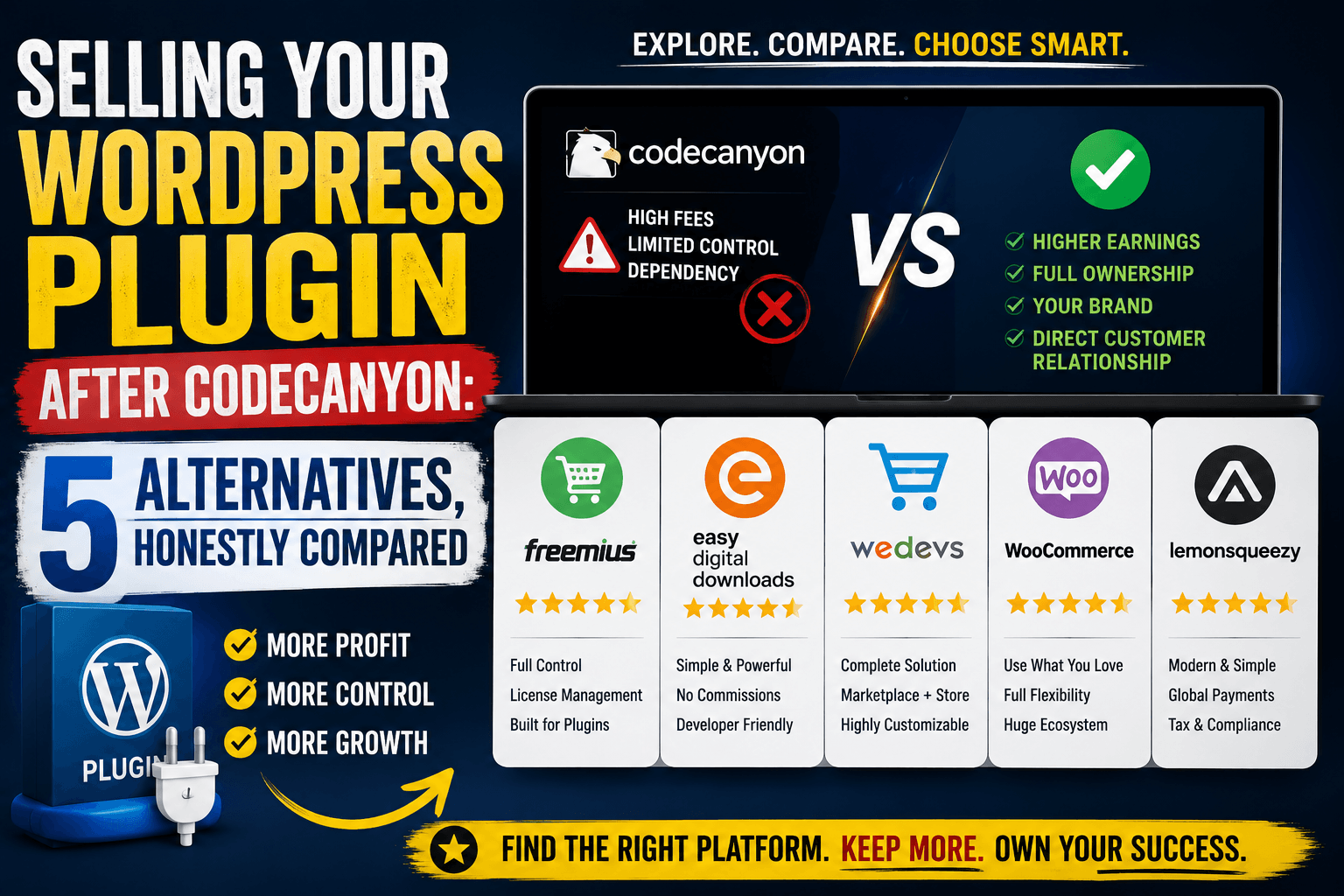
You've built a WordPress plugin that's sold a few hundred copies on CodeCanyon. Then in March 2026, Envato stopped accepting new author applications — and the July 2026 policy changes rewrote payout conditions for existing sellers. The marketplace you built a pricing model around is no longer the same marketplace.
This isn't a "best platforms for digital products" roundup. It's for WordPress plugin and theme authors who were on Envato and need to know what actually fits their situation — without handing another 30–50% to someone else.
What changed with Envato in 2026
Envato closed new CodeCanyon and ThemeForest author applications as of March 2026. For existing authors, the July 2026 policy changes shift payout structures and marketplace conditions significantly. The full breakdown of what changed and what it means for your earnings is in our Envato July 2026 changes guide for WordPress authors.
What matters for this decision: if you're launching a new plugin, CodeCanyon is no longer a viable starting point. And if you're already on it, you're evaluating options now — before July — while there's still time to build something.
The real choice: marketplace or your own store?
Before comparing platforms, name what you're actually deciding between.
Option A: Find another marketplace. Platforms like Creative Market, TemplateMonster, and AppSumo operate on the same model as CodeCanyon. You list your product, they bring traffic, they take a cut — usually 30–50%. Your customer relationship lives on their platform, not yours.
Option B: Own your distribution. You set up a storefront on your own domain, collect revenue minus only the payment gateway fee (Stripe, PayPal), and keep the customer email list. More control, more setup, no automatic discovery traffic.
Most comparison articles treat this as an impossible dilemma and recommend a marketplace because it's simpler. That framing assumes you have no existing audience. A plugin author with 200 customers already has buyers who follow the product, not the platform. The marketplace's discovery engine isn't doing the heavy lifting at renewal time — your plugin is.
5 CodeCanyon alternatives compared
| Platform | Model | Software license keys | Platform fee | Best for |
|---|---|---|---|---|
| Freemius | Merchant of Record | Built-in (full API) | ~5–7% of revenue | Global compliance, established plugins |
| Gumroad | Hosted checkout | Not supported | 10% (free) or $10/mo flat | Non-software digital products |
| Creative Market | Marketplace | Zip delivery only | ~40% cut | Design assets, not plugins |
| EDD + extensions | WordPress plugin (self-hosted) | Via $199+/yr extension | 0% platform fee | WordPress-native sellers |
| ChargePanda | Self-hosted Laravel app | Built-in (REST API) | 0% platform fee | Plugin devs who want full ownership |
Freemius
Freemius is the default for WordPress plugin licensing for good reason. It acts as a Merchant of Record: Freemius handles VAT collection across the EU, processes refunds, and issues license keys with activation limits, domain tracking, and version-gated updates. Your customers technically buy from Freemius, not from you — which removes a real compliance burden for developers selling to buyers across 40+ countries.
The cost is around 5–7% of every transaction on top of payment processing fees. For a plugin priced at $49 with 50 sales per month, that's roughly $120–$170/month in platform fees. Significantly less than CodeCanyon's 30–50%, but still a permanent percentage of every sale. We've compared the full feature set in the Freemius vs. ChargePanda breakdown if you want the feature-by-feature detail.
Gumroad
Gumroad is the simplest setup — active within 30 minutes, no server installation required. The problem for plugin authors: Gumroad doesn't generate or validate software license keys. You'd be delivering a zip file with a readme and relying on the buyer to honor the license terms. For an ebook or Notion template that works fine. For a WordPress plugin that calls a REST API to validate activation on update, Gumroad leaves the licensing problem entirely unsolved.
Creative Market and TemplateMonster
These are marketplaces. You move from Envato's 30–50% cut to Creative Market's ~40% cut or TemplateMonster's variable rates. The dependency structure is identical — your customers belong to the marketplace, discovery depends on the platform's traffic, and you have no direct email relationship with buyers. For design assets and theme packs, both can work. For actively-maintained plugins with license validation requirements, the delivery model is a poor fit.
Easy Digital Downloads with extensions
EDD is the natural recommendation from WordPress-centric developers, and the base plugin is free. The gap appears when you add what a plugin seller actually needs: the software licensing extension runs around $199/year, recurring payments are a separate add-on, and the checkout experience inherits every operational quirk of a WordPress installation. You're adding a full WP stack — security updates, plugin conflicts, hosting configuration — to what is essentially just a payments and delivery layer. For developers already running WordPress sites, this overhead is familiar. For those who'd rather keep their sales infrastructure on its own server, it's unnecessary weight.
ChargePanda
ChargePanda is a self-hosted Laravel application — not a WordPress plugin — that installs on any standard PHP server. License key management is included: key generation, activation limits, domain tracking, and a REST validation API your plugin calls on activation or update check. The perpetual license is $49 one-time. Payment gateway fees (Stripe, PayPal) apply, same as with any other platform.
The honest tradeoffs: setup takes 2–4 hours on a PHP server, not 30 minutes. And ChargePanda isn't a Merchant of Record — you handle your own tax compliance, including EU VAT registration if your sales volume there warrants it. For plugin authors selling primarily to US buyers, or those with an accountant already handling tax, this is manageable. For a developer with significant EU sales from day one and no accounting support, Freemius's MoR layer removes a real burden at a real cost.
When another marketplace still makes sense
If your plugin is new, unproven, and you have no email list or SEO presence — a marketplace solves a discovery problem you can't solve yourself yet. CodeCanyon's failure wasn't that it was a marketplace. It was the fee structure and the policy shifts. A different marketplace with better economics can still provide the first 50–100 sales that validate your pricing and reveal whether your product actually converts.
A few scenarios where staying on a marketplace is the cleaner choice:
- You're launching your first plugin and haven't validated demand yet
- Your buyers specifically browse curated marketplaces when evaluating new tools and you need that association
- You want to test price points before investing in a branded storefront
After 200–500 customers and a stable renewal base, you have the leverage to move distribution to your own domain. Customers follow the product, not the marketplace. A migration email announcing your new direct store typically gets strong response from existing buyers — because they already trust the plugin, not because they're loyal to CodeCanyon.
What self-hosting your store actually costs
A concrete example: a plugin priced at $49 per license, 50 sales per month ($2,450 gross monthly revenue).
| Setup | Monthly platform fee | Monthly gateway fees | Approx. net revenue |
|---|---|---|---|
| CodeCanyon (35% cut) | $858 | — (included) | $1,592 |
| Freemius (~6%) | $147 | ~$86 (Stripe) | ~$2,217 |
| ChargePanda | $0 | ~$86 (Stripe) | ~$2,364* |
*Stripe fees at 2.9% + $0.30/transaction. ChargePanda hosting runs $5–15/month on a shared PHP server. The $49 one-time license fee amortizes to under $1/month over four years. Freemius fee structure varies by plan — verify current rates before committing.
The Freemius vs. ChargePanda delta at 50 sales/month is about $147/month — roughly $1,764/year staying in your pocket vs. going to the platform. At 100 sales/month, that difference is around $3,500/year. Whether the MoR compliance handling is worth that depends entirely on your sales geography and whether you have accounting support for EU VAT.
Moving your existing Envato customers
The part most articles skip: you have 400 customers on CodeCanyon. What happens to them?
Export your customer list from Envato before access conditions change — check Envato's current documentation for export procedures, as they vary. Set up your new store, generate license keys for existing customers, and send a migration email: "We're moving the plugin to our own store. Your license is still active. Click here to register on the new system."
Most buyers don't care where they originally purchased. They care that the plugin keeps working and receiving updates. A small renewal discount for customers who migrate from CodeCanyon is a common pattern for smoothing the transition without it feeling like an inconvenience.
For the full technical setup — installing the store, configuring license key delivery, setting up update servers — the how to sell WordPress plugins on your own website guide covers the complete installation walkthrough.
Frequently Asked Questions
Can Envato authors still sell on CodeCanyon in 2026?
Existing authors with active accounts can continue selling, but Envato stopped accepting new author applications as of March 2026. Payout structures and marketplace conditions for existing sellers have shifted following Envato's acquisition by Shutterstock. Review the current author terms directly with Envato for the latest conditions.
Do these alternatives support software license key management?
Freemius and ChargePanda both include native license key management — activation limits, domain tracking, version-gated updates, and a REST validation API. Gumroad and Creative Market do not support software licensing in any meaningful way. EDD requires a separate paid extension (around $199/year) to add licensing to the base plugin.
What's the fastest way to start selling without Envato?
Gumroad is the fastest to set up — under 30 minutes — but it doesn't support software license keys. ChargePanda takes 2–4 hours for a full installation on a PHP server, with license management included out of the box. Freemius requires integrating their SDK into your plugin's codebase before you can list it for sale.
How do I handle EU VAT without a Merchant of Record?
Without a Merchant of Record like Freemius, VAT registration in EU countries becomes your responsibility above certain revenue thresholds. Most US-based developers selling primarily to US buyers can defer this question. For plugin authors with significant EU volume, the MoR model removes the compliance burden at the cost of a 5–7% platform fee on every transaction.
Is my pricing on Envato still competitive if I sell from my own store?
In most cases, yes — and you gain more flexibility. On your own store you control annual renewal pricing, bundle deals, upgrade paths, and tiered licensing without marketplace restrictions. Plugin authors who move to direct sales typically maintain or improve per-customer revenue because they own the checkout experience and the customer relationship.
Where to start
The decision comes down to two questions: do you need Merchant of Record compliance from day one, and do you have the setup time for a self-hosted store?
If you have an existing plugin audience and sell primarily to US buyers, ChargePanda's pricing page covers what the $49 perpetual license includes — licensing, checkout, subscriptions, and a 14-day trial to test every feature before committing. Your server, your rules, no percentage leaving every month.
If global VAT compliance needs to be handled automatically from the start, Freemius is the defensible choice. You pay the 5–7% permanently, but you buy back the compliance overhead. The two aren't mutually exclusive — some plugin authors run Freemius for international sales and a self-hosted store for direct domestic sales as volume grows.
And if you're still on your first plugin with no existing audience: validate on a marketplace first. Migrate once you know the pricing holds and you have 200+ customers who care enough to follow you to your own store.
ChargePanda Support
ChargePanda Support is the editorial team at ChargePanda — a self-hosted platform helping developers and digital product sellers manage licensing, file delivery, subscriptions and support from one place.